Showing posts with label Structural Engineering. Show all posts

Sunday, July 8, 2012

A challenge from the kids

After the last gumdrop tower challenge T and M told me to build my own tower if I thought I could do a better job (in response to my suggesting they work more triangles into the structure).

I tired to think about how to reduce the weight up top but make it sturdy lower down to prevent the structure from buckling.  Again I was limited to an 8 1/2" base.  At first I tried a dense core of two tetrahedon stacks superimposed on each other (rotatred 180 degrees) with a wide base.

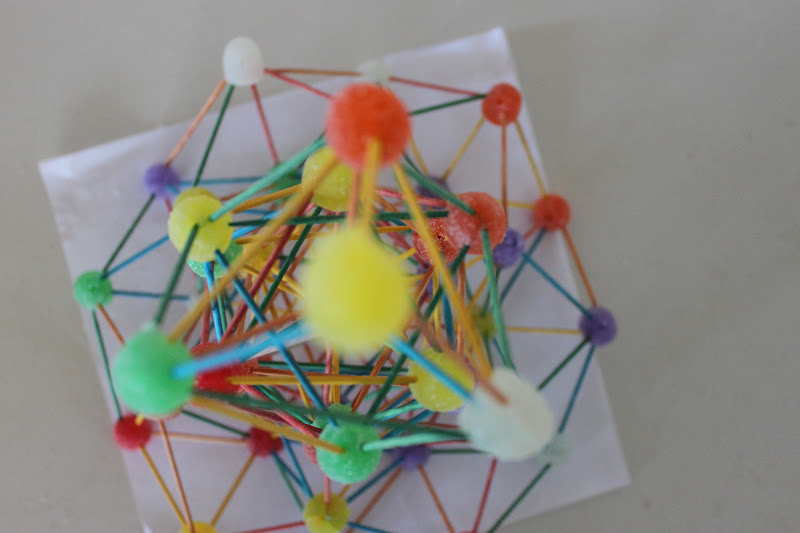

Then I stacked a less dense, light weight, frame over this base and extending much higher.


I like the patterns it makes when you look through these kinds of structures. 

 
However, it wasn't completely stable and the « head » slumped to the side and fell off a few hours later leaving the height at 18". 


So I tried a different strategy.  Warren trusses are very stable in one plane.  So I tried coming up with a three-dimensional generalization of a warren truss.  This is certainly possible but not easy to do when the edges are all the same length (toothpicks) and the vertices (gumdrops) must come at the ends of the toothpicks.  In other words tetrahedrons don't stack in a straight line. 


Above are some examples I used to try to visually think through this.  In the lower center is a tetrahedron.  To the left is a icosahedron that arises from packing tetrahedrons together.  To the right is a warren truss in two planes, but they result in weaker square links to each other along the remaining edge. 

Then I thought about the fact that, given the same weight and material, hollow tubes are stronger than solid rods.  (If you drilled half of the volume out of the center of a rod to make a hollow tube you loose half the weight but not half the strength.)  So I tried wrapping a warren truss around in a cylinder and stacking the cylinders.  It quickly became apparent however that I needed to brace each layer from the center to prevent the cylinder from deforming.  I did this with a single chain of gumdrop toothpicks that do not provide any support in vertical planes, only in the horizontal plane. 


This approach gave a nice dual spiral pattern around the outside of the cylinder.  I managed to build it to a stable height of 16", which was only 2" lower than my previous attempt but it used a lot less material (and also the gum drops had been reused several times and were about to fall apart anyway).  Perhaps a combination of the two approaches would work even better, a dense core at the base and a « warren tube » extending up from that?

Monday, June 25, 2012

Gumdrop and toothpick tower building challenge


The rules were, the base of the tower has to fit on a 8 1/2" square of paper (the paper could be cut into multiple pieces if wanted so that each part of the base fits on it).  Whoever builds the tallest, freestanding, tower out of gum drops and toothpicks at the end wins.  At first everything seems stable, but after a certain height it deforms uncontrollably, which is exactly what I was going for.  M went for a 3D grid.  T built a « ring » with triangles worked in in the horizontal plane.  After a while, T's construction sprouted arms, hands and eyes and he named it "tower man."  T was also being funny by saying things like "work harder not smarter" and "spare every expense!"  They both talked almost the entire time despite eating the gumdrops.  In the end M won by taking her tower apart and stacking four independent cubes. 

Monday, February 27, 2012

Egg drop (but not the soup)

Eggs aren't just for use in radiators.  For our latest home STEM project we made devices to protect eggs when they are dropped.  T, M and I were each limited to 100 plastic "bendy" straws, two rolls of scotch tape, two sheets of paper towel, and a plastic cup.  We bartered these items around; for example I traded my paper towels and cup for more straws and tape. 


M cut up straws into short pieces and used them as filler, like styrofoam peanuts, inside the cup.  The egg was wrapped in a paper towel in the middle.  She taped that in then lined the sides of the cup with straws against impact.


T's design used the least straws.  He used two cups and had one cut smaller and inverted inside the other.  The smaller one could compress inside the larger and create a shock absorber effect.  He wrapped the egg in a paper towel inside and had a few straws to cut and place around the outside haphazardly.


In my design the top is a 20 sided icosahedron with the egg just slightly below the center to give a "down" weighting.  I taped across the top 10 faces to act as a parachute (with a small gap at the apex to help stabilize it).  I used the remaining tape and straws to add legs at various angles to the lowest point to break the initial impact and convert the falling motion into a roll away motion.   


It unintentionally turned out looking a little like a virus particle.

 Time to test them out.  We started off with short drops of 3 feet and 5 feet onto concrete. 


No eggs were broken so we had to move to higher drops.


Everything worked at seven feet.  My virus parachuted down and rolled away.  At nine feet T's contraption flew apart on impact, but the egg was unbroken!  However, M's egg finally broke at the nine feet drop. 


After this point we had to climb onto the garage roof to get greater height over the cement.   


Tossing it off the roof at 12 feet finally broke T's egg!  The virus egg did fine.  It parachuted down at the same speed as before.

T and M are already demanding a rematch.  They have new ideas now for modifications.

Thursday, February 16, 2012

Triangles and Bridges

The kids and I have been working on some geometry.  One part of this is showing how polygons can be subdivided into triangles.  I had T work out the formula t = s - 2; the number of triangles, t, needed to build a polygon with s sides.

Also I showed the connection between reducing a square into two triangles to reducing a square number, 2x2=4, 3x3=9, 4x4=16, ... to two triangular numbers 4=3+1, 9=6+3, 16=10+6, where 1, 3, 6, 10, ... are triangular numbers (can be arranged in a triangle, see my earlier post about pairwise comparisons). 

I also tried to illustrate how a triangle is more stable than a square to bending.  This led to a bridge building experiment the next day.  I picked up two bags of gum drops and a box of toothpicks from the grocery store.  I gave the kids 100 toothpicks each (midway we increased this to 110) and told them to build a bridge between two blocks (borrowed from F) one foot apart.  Then we would test how much weight they could hold before buckling.  (As a kid I tried to do something like this in my grandma's kitchen with bread dough and toothpicks; I refined my initial idea by looking online and seeing the post about gumdrop bridges at Beck Logan's STEM Blog.) M immediately said she would use triangles because that's how the Eiffel Tower is built. 

The kids really got into it.  This was a lot of fun.

Getting Started.  M has a pyramid base up already. 

Some more shapes appear. 

Taking Shape
T went for a Warren Truss design, a weight efficient pattern used in airplanes.  He also has a stick and gumdrop bystander.

M went for a series of interconnected pyramids with a complex base on each block. 

Measuring the fit. 

T's completed bridge, using 103 toothpicks, supporting four pencil weights.


T's bridge supporting 10 pencils.  At 10 it is starting to bend under the weight, but is still holding. 

Structural failure at 11 pencil weights. 

M redesigned her bridge a bit with anchors and weights at the ends to try to keep it from sagging so much as it pulled toward the middle. 

Placing the fifth pencil. 

Failure at six pencils. 

I didn't want to be left out of the fun so I made a bridge that combined the two kids designs and used exactly 110 toothpicks.  A Warren Truss with a row of pyramids on top to support against compression of the top edge. 

The combined design holding 12 pencils.

Structural failure at 16 pencil weights!