Showing posts with label Politics. Show all posts
Showing posts with label Politics. Show all posts
Wednesday, October 3, 2012
Registered to Vote
The deadline for registering is fast approaching, so I filled out a Hawai'i voter reregistration form (link), filled it out, and dropped it off this morning. The guy took it away and then looked back at me, non-verbally asking what else I was waiting for. I asked if he needed to see any ID or utility bills with my address (which I had brought with me) and he said "no, that's it." I haven't registered to vote in many years but this made me suspicious. I'm worried on election day that there will be a problem. I'm planning to take ID and utility bills (with my address on them) with me when I go to vote so I can show the people at the polling place if there are any problems.

Friday, September 28, 2012
Preemptive War with Iran
All the rhetoric in the news lately about Iran worries me. Here is the latest (link) about Israel demanding countries adopt a "red line" that once crossed will result in war. Earlier in the year a lot of the discussion was if a preemptive strike against Iran was needed sooner rather than later...
All of this seems like preparing the public to accept a war; much like the rhetoric about invading Iraq by the Bush administration. Now, with all the cost in lives and to the economy can anyone articulate a clear reason we (the US) did invade Iraq?
Let's step back a minute and ask ourselves, what has Iran done? Like many, many countries Iran has a nuclear program. Iran may or may not be developing a nuclear weapon; we don't know. Iran has said they are not developing nuclear weapons and it is not a given that if a country has a nuclear program it will use it to develop nuclear weapons. We do know however that many other countries have developed nuclear weapons and have not used them to attack other countries (except for one, the United States). Pakistan and India were on the edge of war not that many years ago but choose not to use nuclear weapons against each other. China and Taiwan, both of which have or had nuclear programs, have not nuked each other. Thankfully, the US and USSR did not use them against each other during the Cold War. North Korea has not used nuclear weapons on South Korea, etc. South Africa, Brazil, Argentina, etc. have began nuclear weapon programs in the past but then discontinued them. South Africa even built six warheads but later dismantled them. So it is not a given that a country will develop nuclear weapons, continue to develop them, maintain them, or actually use them, if they have a nuclear program, even if they are at war.
There is also the flip side of this coin. It is well known that, in all likelihood, Israel, which is pushing countries to rally against Iran, has nuclear weapons (link). Part of the rhetoric is that Iran needs to live up to its "responsibilities" in the international community. Well, for example, Israel has repeatedly refused to sign the international nuclear Non-Proliferation Treaty (NPT, link), which Iran has signed. Also, how can we expect countries not to develop their own nuclear deterrents if we threaten them with nuclear weapons? We threatened Iraq with nuclear bunker busters, and statements have been made, from the US, a nuclear weapon country, that "all options are on the table."
If we really want to prevent war and proliferation then a noble first step would be for Israel to sign the non-proliferation treaty like Iran, and/or publicly give up it's nuclear weapons (what are they really going to use them for anyway?) and/or for the US to publicly state that it will not use nuclear weapons against Iran.
All of this seems like preparing the public to accept a war; much like the rhetoric about invading Iraq by the Bush administration. Now, with all the cost in lives and to the economy can anyone articulate a clear reason we (the US) did invade Iraq?
Let's step back a minute and ask ourselves, what has Iran done? Like many, many countries Iran has a nuclear program. Iran may or may not be developing a nuclear weapon; we don't know. Iran has said they are not developing nuclear weapons and it is not a given that if a country has a nuclear program it will use it to develop nuclear weapons. We do know however that many other countries have developed nuclear weapons and have not used them to attack other countries (except for one, the United States). Pakistan and India were on the edge of war not that many years ago but choose not to use nuclear weapons against each other. China and Taiwan, both of which have or had nuclear programs, have not nuked each other. Thankfully, the US and USSR did not use them against each other during the Cold War. North Korea has not used nuclear weapons on South Korea, etc. South Africa, Brazil, Argentina, etc. have began nuclear weapon programs in the past but then discontinued them. South Africa even built six warheads but later dismantled them. So it is not a given that a country will develop nuclear weapons, continue to develop them, maintain them, or actually use them, if they have a nuclear program, even if they are at war.
There is also the flip side of this coin. It is well known that, in all likelihood, Israel, which is pushing countries to rally against Iran, has nuclear weapons (link). Part of the rhetoric is that Iran needs to live up to its "responsibilities" in the international community. Well, for example, Israel has repeatedly refused to sign the international nuclear Non-Proliferation Treaty (NPT, link), which Iran has signed. Also, how can we expect countries not to develop their own nuclear deterrents if we threaten them with nuclear weapons? We threatened Iraq with nuclear bunker busters, and statements have been made, from the US, a nuclear weapon country, that "all options are on the table."
If we really want to prevent war and proliferation then a noble first step would be for Israel to sign the non-proliferation treaty like Iran, and/or publicly give up it's nuclear weapons (what are they really going to use them for anyway?) and/or for the US to publicly state that it will not use nuclear weapons against Iran.
Monday, June 25, 2012
Arizona's immigration law
V alerted me to the Supreme Court's ruling striking down parts of Arizona's controversial law. Here is a news link.
While I would like for the world to be free and open so that anyone could live and work anywhere, I understand this is not the reality of the situation and we are bound by the circumstances of our birth which results in our citizenship, or lack of citizenship, status. It is hard to think of anything more arbitrary and unfair in the modern world's laws.
Anyway, countries have a legal right to deport illegal immigrants. If anything, living as a non-citizen immigrant in Europe has made me less tolerant of illegal immigrants in the US (I know that may sound counter intuitive). However, we should have humanitarian limits to this. The part of the law that the courts upheld, that police check the immigrant status of people they interact with, worries me. This means that if illegal immigrants are being unfairly treated or taken advantage of they can not go to the police for help, much in the same way blackmail is used to prevent people from going to the police. This makes illegal immigrants targets for extortion. There should be an immunity clause where immigrants can not be deported as a result of going to the police for protection, to help solve this situation.
While I would like for the world to be free and open so that anyone could live and work anywhere, I understand this is not the reality of the situation and we are bound by the circumstances of our birth which results in our citizenship, or lack of citizenship, status. It is hard to think of anything more arbitrary and unfair in the modern world's laws.
Anyway, countries have a legal right to deport illegal immigrants. If anything, living as a non-citizen immigrant in Europe has made me less tolerant of illegal immigrants in the US (I know that may sound counter intuitive). However, we should have humanitarian limits to this. The part of the law that the courts upheld, that police check the immigrant status of people they interact with, worries me. This means that if illegal immigrants are being unfairly treated or taken advantage of they can not go to the police for help, much in the same way blackmail is used to prevent people from going to the police. This makes illegal immigrants targets for extortion. There should be an immunity clause where immigrants can not be deported as a result of going to the police for protection, to help solve this situation.
Wednesday, June 20, 2012
Local school funding
Why are public schools in the US primarily funded by local property taxes? It is hard to think of a clearer example of class discrimination in this country. People with higher educations tend to have higher incomes and can live in areas where property is more expensive, which means the local schools are better funded so that their children have better educations and the process continues to repeat. Lower income people can only afford areas with lower property values and less well funded public schools for their children. The US system works to separate people by class and strongly reenforces this generation after generation. Why do we allow this?
I have seen arguments that it is « unfair » for richer school districts to spend more on poorer school districts, but the poorer ones don't have the money to spend in the first place. It is not like they are cheating the system and keeping extra money somehow. Also, we are talking about children's education here; a part of the population that has no say in how the system is set up and is not allowed to make these choices that are critically important to the rest of their lives.
It is like the argument that retired people should not pay taxes for schools because their children are not in school. Does anyone ask people that are still working and do not have children if they would like to not pay taxes⸮ Should people pay more taxes for each child they have⸮ Of course not. It is better for everyone if we all live up to our fullest potential. Do retired people not care about their grand-children's generation⸮ When retired people have medical issues and go to the hospital they want the personnel to have a good education, but some are trying to get out of paying for it. Similarly, people in rich areas complain about crime in poorer areas, but they want to keep their public education taxes local and reenforce the negative cycle in poorer districts.
Being limited in education and thus job opportunities from generation to generation is like creating a caste system. Funding for public schools needs to be disconnected from local taxes. Is there any reasonable argument to the contrary?
I have seen arguments that it is « unfair » for richer school districts to spend more on poorer school districts, but the poorer ones don't have the money to spend in the first place. It is not like they are cheating the system and keeping extra money somehow. Also, we are talking about children's education here; a part of the population that has no say in how the system is set up and is not allowed to make these choices that are critically important to the rest of their lives.
It is like the argument that retired people should not pay taxes for schools because their children are not in school. Does anyone ask people that are still working and do not have children if they would like to not pay taxes⸮ Should people pay more taxes for each child they have⸮ Of course not. It is better for everyone if we all live up to our fullest potential. Do retired people not care about their grand-children's generation⸮ When retired people have medical issues and go to the hospital they want the personnel to have a good education, but some are trying to get out of paying for it. Similarly, people in rich areas complain about crime in poorer areas, but they want to keep their public education taxes local and reenforce the negative cycle in poorer districts.
Being limited in education and thus job opportunities from generation to generation is like creating a caste system. Funding for public schools needs to be disconnected from local taxes. Is there any reasonable argument to the contrary?
US citizen, in the US, denied sale because of ancestry!
Here is a link to a news article pointed out to me by V. A woman, who is a US citizen, in Georgia was denied the sale of an ipad in an Apple store because she spoke Farsi.
Thursday, May 24, 2012
Individually Adjusting Insurance Rates
The basic idea of insurance is to share risk. Someone in
a group will get sick or have an accident, it could happen to anyone,
so by buying insurance as a group the cost that would have happened to
one or a few people is divided up among all people.

In this hypothetical example, 10 people had an average expense of $4,000 per some time unit (red). However, all but two were much lower than $4,000 and two, Martha and Sam, had much higher expense (blue). So this illustrates uncertainty--the driving idea of insurance. Of course the insurance company has its own expenses so say each person paid a bit higher than average, $5,000 per unit time, to the insurance company to cover these expenses (yellow). So the total expense paid out is $40,000 for all 10 people and the total payment to the insurance company is $50,000. (Of course this ignores insurance companies refusing to pay for things they said were covered when you bought the insurance. I have had plenty of experiences with that (refusing to pay the very thing that is in their booklet of covered expenses) but that is a different issue and for the moment lets just pretend the insurance company is honest and does what it says it will do--wouldn't that be nice⸮)

Now, say the insurance company has information about you. This could be anything, driving habits, medical, employment, credit rating, neighborhood you live in, ... The insurance company might then adjust your rates according to your predicted risk. This is good for the company, most people pay lower rates and the company will attract more of these lower risk people, but a few people pay higher rates based on risk factors. The company doesn't want to insure these people anyway and it would help the company if they went elsewhere for insurance. In the example above, the expenses and average is the same (a total expense of $40,000 for 10 people). The payment to the insurance company is the same (a total of $50,000), but there is a lower standard rate of $3,000 per person because some people pay a higher rate based on individual risks.
This is very good for the insurance company and on the surface it might seem fair to the consumers. Why should we all pay for a subset of people that choose risky lifestyles, etc. In fact it could be argued that this will actively encourage people to "clean up their act." But what if these risk factors are things people have no control over, like prior medical history or family history of a disease, etc. Also, in John's case above, he paid a higher rate but the company bet wrong; he actually had lower expenses for the period.
Now let's carry this to a ridiculous extreme to make a point. Say the insurance company had perfect predictive power; that they were able to essentially exactly predict the expense associated with each person over a long time period. What would the individuals expenses look like⸮

Above, the totals are exactly the same again, but the insurance payments are adjusted exactly according to each persons expense. Of course the company has its own internal expenses, so each person pays a bit more than their covered expense. In other words it would be better for all of these people to not have any insurance at all and just pay their own expenses. When the insurance company uses more and more information to reduce risk uncertainty, they are undermining the very reason for individuals to have insurance in the first place. There is no more shared risk and the people are just supporting a parasitic company for no benefit to themselves.

In this hypothetical example, 10 people had an average expense of $4,000 per some time unit (red). However, all but two were much lower than $4,000 and two, Martha and Sam, had much higher expense (blue). So this illustrates uncertainty--the driving idea of insurance. Of course the insurance company has its own expenses so say each person paid a bit higher than average, $5,000 per unit time, to the insurance company to cover these expenses (yellow). So the total expense paid out is $40,000 for all 10 people and the total payment to the insurance company is $50,000. (Of course this ignores insurance companies refusing to pay for things they said were covered when you bought the insurance. I have had plenty of experiences with that (refusing to pay the very thing that is in their booklet of covered expenses) but that is a different issue and for the moment lets just pretend the insurance company is honest and does what it says it will do--wouldn't that be nice⸮)
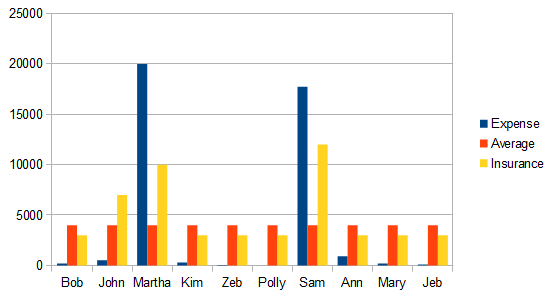
Now, say the insurance company has information about you. This could be anything, driving habits, medical, employment, credit rating, neighborhood you live in, ... The insurance company might then adjust your rates according to your predicted risk. This is good for the company, most people pay lower rates and the company will attract more of these lower risk people, but a few people pay higher rates based on risk factors. The company doesn't want to insure these people anyway and it would help the company if they went elsewhere for insurance. In the example above, the expenses and average is the same (a total expense of $40,000 for 10 people). The payment to the insurance company is the same (a total of $50,000), but there is a lower standard rate of $3,000 per person because some people pay a higher rate based on individual risks.
This is very good for the insurance company and on the surface it might seem fair to the consumers. Why should we all pay for a subset of people that choose risky lifestyles, etc. In fact it could be argued that this will actively encourage people to "clean up their act." But what if these risk factors are things people have no control over, like prior medical history or family history of a disease, etc. Also, in John's case above, he paid a higher rate but the company bet wrong; he actually had lower expenses for the period.
Now let's carry this to a ridiculous extreme to make a point. Say the insurance company had perfect predictive power; that they were able to essentially exactly predict the expense associated with each person over a long time period. What would the individuals expenses look like⸮

Above, the totals are exactly the same again, but the insurance payments are adjusted exactly according to each persons expense. Of course the company has its own internal expenses, so each person pays a bit more than their covered expense. In other words it would be better for all of these people to not have any insurance at all and just pay their own expenses. When the insurance company uses more and more information to reduce risk uncertainty, they are undermining the very reason for individuals to have insurance in the first place. There is no more shared risk and the people are just supporting a parasitic company for no benefit to themselves.
Thursday, April 26, 2012
The Future Party
A big problem with American politics are short term fixes that are penny wise and pound foolish. What if we put together a political party that focused on the long term picture solely to invest in the future of the US⸮
I am all for individual self-determination, rights and freedoms, but this doesn't mean we can't take part in collective actions--that we can not do alone--if we decide to do so together as a democracy. The best way to start long term investment in the future of the country is to promote education, health care, and reduce debt. Another component is to promote a sound economic infrastructure, like rail travel, renewable energy and basic research.
How to encourage politicians⸮ What if we pegged politician retirement income and benefits to the median income, updated yearly, of US citizens (or people living in the US, not just citizens, whichever is lower)? Also, what if we spread out terms over a longer time period so that politicians could not serve consecutive terms but could serve alternate terms (perhaps at half the time span, elected once and serve twice over a longer period)?
I am all for individual self-determination, rights and freedoms, but this doesn't mean we can't take part in collective actions--that we can not do alone--if we decide to do so together as a democracy. The best way to start long term investment in the future of the country is to promote education, health care, and reduce debt. Another component is to promote a sound economic infrastructure, like rail travel, renewable energy and basic research.
How to encourage politicians⸮ What if we pegged politician retirement income and benefits to the median income, updated yearly, of US citizens (or people living in the US, not just citizens, whichever is lower)? Also, what if we spread out terms over a longer time period so that politicians could not serve consecutive terms but could serve alternate terms (perhaps at half the time span, elected once and serve twice over a longer period)?
Monday, March 19, 2012
UNESCO and Palestine
The US has cut its funding to UNESCO. Why? Because UNESCO has included Palestine as a member. The US has a law that any UN organization that recognizes Palestine can not be funded by the US. Israel is recognized by the UN, why can't Palestine also be recognized? Forget about fairness for a moment, cutting UNESCO funding hurts our own interests. Countries like Gabon, who has pledged 2 million, have stepped up to try to fill the gap so that humanitarian missions can continue. If you think the US should cut down in funding international programs in general, how about starting with the 3 billion annually to Israel? Or at least equalize the support between Israel and Palestine? The Daily Show, the counter weight to moronic "news" shows, has a special segment on this. I recommend skipping the intro and going straight to John Oliver's interview (below are direct links to the segments).
http://www.thedailyshow.com/watch/thu-march-15-2012/march-15--2012---pt--3

http://www.thedailyshow.com/watch/thu-march-15-2012/march-15--2012---pt--4
Energy Production in Hawai'i
Hawai'i is in an amazing position to take advantage of renewable energy. There is great potential for wave, wind, solar, and geothermal here. Despite this, 90% of energy production comes from oil imported to Hawai'i, which makes this one of the highest rates for electricity in the nation (link and link). This is crazy. In response people have started putting up solar panels on their homes and now Hawai'i is the second in the nation, per capita, for solar power use. Companies have sprung up that will install panels on your house for free, and you pay your (lower) electric bill to them to recoup the cost. This allows homeowners to get into solar without an upfront money barrier (besides owning the home of course). However, there is an attempt here to stop solar. I heard it on the radio driving home from work and couldn't believe it. Recall that electricity is run as a monopoly that is coordinated through government regulations, and does not operate as a free capitalist market. The Hawaii Public Utilities Commission has set a limit of 15% of energy that can come from renewable sources, the rest has to come from oil! On the radio I heard that several areas are at this limit and there is effectively a moratorium on adding solar in some neighborhoods (but I have not been able to verify this last point independently). This is being fought by several solar and renewable energy organizations that are managing to get some amendments made to the ruling (link).
Tuesday, March 6, 2012
99% movement
I only recently learned more about the occupy movement and "we are the 99%" slogan. Chalk it up to being too busy working and moving a family between continents to stay on top of the news.
There is an occupy Honolulu camp in town that the police and city council have been forcing out of the park. I looked up more info about all of this.
I can certainly understand the frustration based on my own experiences. I am very pro-education, but in a strictly monetary view it does not make sense to go to grad school. Today people that begin working straight out of college make more over a lifetime than people with higher degrees. With higher degrees you go deeper into debt and spend many years making very little money. People are surprised to learn that as a postdoc (that's with a Ph.D.) at Harvard (that's Ivy League) you may make only $18,000 a year.
This is effectively less when you consider paying off college loans at the same time. And what if you have a family with dependents?
I encouraged a distant cousin of mine to go to college. Instead he went straight into his father's business after high school. He is doing much better financially than I and many people I know who went to college. This makes it hard to encourage other people to go to college.
College tuitions are unreal; it is impossible to work your way through college. (I always had a job while in college--from a janitor mopping floors to landscaping digging ditches to a security guard trying to stay awake all night--but it was never enough to pay for college.) And, your parents incomes are included in your financial calculations whether they help to pay for college or not. Also, graduate schools take advantage of students. There is the assumption you do not have dependents and the low levels of support are justified. You are required to spend thousands of dollars on things you do not need. (Example, I was forced to buy health insurance from a specific company each year in order to register for classes. I already had insurance covering me from my wife's job. Then when it came time to pay up medical bills they refused, even though it was listed as a covered expense in their handbook. So I was forced to pay for something I couldn't afford, didn't need, and gave no benefits.) And you are paid like a company town, on paper you receive money for support, but you never see all that money because it is taken right back out by the university. Also, judges have ruled that grad students are not employees and do not have the same legal protections (for example, can not organize to go on strike and refuse to teach classes).
The irony of the college situation is, we can not save for our children's college because we are paying off our own education. I opened 529 savings accounts many years ago for the kids but have only been able to put in a small amount. It is not like we are not trying to save. I also opened an IRA over a decade ago to save for retirement. I've barely been able to put in anything beyond the initial $500 to open the account. With some very lucky investments I have grown that to several thousand, but that is still nothing to retire on. (And by the way, my time spent in grad school--where I was not legally an employee, even though I worked and paid taxes--doesn't count for social security benefit calculations.)
Also, it is not like we are spending money freely. Our biggest expense after rent is health insurance (I have always made sure the kids are covered) and college loans. Then we have the utility bills, etc. We keep things turned off and try to use as little water and electricity as possible. We do cost comparisons at the grocery store and buy cheaper bulk food. I have a budget and keep track of every penny of every expense using finance software (moneydance). We would have gone under long ago if I didn't. We live cheaply. I only buy new clothes if I have to (and we get donated clothes). We have only one vehicle for a five person family. We have never owned a new car. We do not have many basic things like a microwave oven, etc. because we can get by without them. Until only recently, a little over a year ago, I never even had a cell phone (I now have a prepaid plan). My biggest indulgence in the last 10 years is my camera (my computer is a necessity for my job) and one-on-one trips with my family in 2010 (that I planned for years to do before the kids were too old). Despite all that, we are used to living from paycheck to paycheck. Usually with a gap of several days where we simply don't have any money left and are broke. Usually we keep up with rent but right now I am behind (and communicated this with our landlord so there are no surprises). Whenever we do have extra money I use it to pay off as much debt as possible. I hate to complain. I have traveled in other countries and seen what true poverty is like, but I think people in general have a mistaken idea of what my generation and people like me have to put up with financially in the US. And apparently this is more widespread than I realized.
Also, it is not like I am lazy and not working. I used to work nights, weekends, almost continuously for years in past jobs. V and I have both worked multiple jobs at times. I forced myself to stop working so much because of my health and to spend time with my family. And V and I work very hard teaching the kids to make up for a broken public education system.
I believe in paying my debts and have never planned to declare bankruptcy. However, for people in my situation this wouldn't really change anything. Educational loans are specifically exempt from bankruptcy; even if you are found bankrupt because you can't pay the loans, you still have to pay them. Why then are other people allowed to get out of car loans, house loans, and consumer debt? And companies, that should be allowed to go under if we practiced capitalism, are bailed out? (And trillions are wasted on pointless wars... )
A further difficulty is the higher your education the fewer jobs that are out there, which means you may have to move larger distances to find a job. I had to move out of the US to find a job to continue my career, which also meant I faced fines, based on past support, for leaving the US (even though it was to get a job). People in the military that move to other countries have a support structure that we can not benefit from. (As do many people that work in large companies or work for the government.) This goes all the way down to simple little things like buying a newspaper. In Germany there is a cheaper price for people in the military and then the price I had to pay. I am not trying to put down people in the military, just to point out how people can easily fall through the cracks of support structures that are assumed to be there. (We end up getting charged more to offset the lower prices of other people. And other people I talked to that had lived in Germany seemed to be unaware that I did not have the same advantages as them.) Also, my work in Germany does not count for US retirement, and my work in the US doesn't count for German retirement. So I loose out on retirement savings yet again.
Sorry about the rant. The point is, is this a system we want? Or, should we change things to encourage people to become highly educated, if they choose to do so, and be able to save for their and their children's future, which would benefit all of us in the long run?
-----
Update: Another irony is that "new" college professors do not make enough to pay off their own college loans. I know of more than one case.
There is an occupy Honolulu camp in town that the police and city council have been forcing out of the park. I looked up more info about all of this.
I can certainly understand the frustration based on my own experiences. I am very pro-education, but in a strictly monetary view it does not make sense to go to grad school. Today people that begin working straight out of college make more over a lifetime than people with higher degrees. With higher degrees you go deeper into debt and spend many years making very little money. People are surprised to learn that as a postdoc (that's with a Ph.D.) at Harvard (that's Ivy League) you may make only $18,000 a year.
This is effectively less when you consider paying off college loans at the same time. And what if you have a family with dependents?
I encouraged a distant cousin of mine to go to college. Instead he went straight into his father's business after high school. He is doing much better financially than I and many people I know who went to college. This makes it hard to encourage other people to go to college.
College tuitions are unreal; it is impossible to work your way through college. (I always had a job while in college--from a janitor mopping floors to landscaping digging ditches to a security guard trying to stay awake all night--but it was never enough to pay for college.) And, your parents incomes are included in your financial calculations whether they help to pay for college or not. Also, graduate schools take advantage of students. There is the assumption you do not have dependents and the low levels of support are justified. You are required to spend thousands of dollars on things you do not need. (Example, I was forced to buy health insurance from a specific company each year in order to register for classes. I already had insurance covering me from my wife's job. Then when it came time to pay up medical bills they refused, even though it was listed as a covered expense in their handbook. So I was forced to pay for something I couldn't afford, didn't need, and gave no benefits.) And you are paid like a company town, on paper you receive money for support, but you never see all that money because it is taken right back out by the university. Also, judges have ruled that grad students are not employees and do not have the same legal protections (for example, can not organize to go on strike and refuse to teach classes).
The irony of the college situation is, we can not save for our children's college because we are paying off our own education. I opened 529 savings accounts many years ago for the kids but have only been able to put in a small amount. It is not like we are not trying to save. I also opened an IRA over a decade ago to save for retirement. I've barely been able to put in anything beyond the initial $500 to open the account. With some very lucky investments I have grown that to several thousand, but that is still nothing to retire on. (And by the way, my time spent in grad school--where I was not legally an employee, even though I worked and paid taxes--doesn't count for social security benefit calculations.)
Also, it is not like we are spending money freely. Our biggest expense after rent is health insurance (I have always made sure the kids are covered) and college loans. Then we have the utility bills, etc. We keep things turned off and try to use as little water and electricity as possible. We do cost comparisons at the grocery store and buy cheaper bulk food. I have a budget and keep track of every penny of every expense using finance software (moneydance). We would have gone under long ago if I didn't. We live cheaply. I only buy new clothes if I have to (and we get donated clothes). We have only one vehicle for a five person family. We have never owned a new car. We do not have many basic things like a microwave oven, etc. because we can get by without them. Until only recently, a little over a year ago, I never even had a cell phone (I now have a prepaid plan). My biggest indulgence in the last 10 years is my camera (my computer is a necessity for my job) and one-on-one trips with my family in 2010 (that I planned for years to do before the kids were too old). Despite all that, we are used to living from paycheck to paycheck. Usually with a gap of several days where we simply don't have any money left and are broke. Usually we keep up with rent but right now I am behind (and communicated this with our landlord so there are no surprises). Whenever we do have extra money I use it to pay off as much debt as possible. I hate to complain. I have traveled in other countries and seen what true poverty is like, but I think people in general have a mistaken idea of what my generation and people like me have to put up with financially in the US. And apparently this is more widespread than I realized.
Also, it is not like I am lazy and not working. I used to work nights, weekends, almost continuously for years in past jobs. V and I have both worked multiple jobs at times. I forced myself to stop working so much because of my health and to spend time with my family. And V and I work very hard teaching the kids to make up for a broken public education system.
I believe in paying my debts and have never planned to declare bankruptcy. However, for people in my situation this wouldn't really change anything. Educational loans are specifically exempt from bankruptcy; even if you are found bankrupt because you can't pay the loans, you still have to pay them. Why then are other people allowed to get out of car loans, house loans, and consumer debt? And companies, that should be allowed to go under if we practiced capitalism, are bailed out? (And trillions are wasted on pointless wars... )
A further difficulty is the higher your education the fewer jobs that are out there, which means you may have to move larger distances to find a job. I had to move out of the US to find a job to continue my career, which also meant I faced fines, based on past support, for leaving the US (even though it was to get a job). People in the military that move to other countries have a support structure that we can not benefit from. (As do many people that work in large companies or work for the government.) This goes all the way down to simple little things like buying a newspaper. In Germany there is a cheaper price for people in the military and then the price I had to pay. I am not trying to put down people in the military, just to point out how people can easily fall through the cracks of support structures that are assumed to be there. (We end up getting charged more to offset the lower prices of other people. And other people I talked to that had lived in Germany seemed to be unaware that I did not have the same advantages as them.) Also, my work in Germany does not count for US retirement, and my work in the US doesn't count for German retirement. So I loose out on retirement savings yet again.
Sorry about the rant. The point is, is this a system we want? Or, should we change things to encourage people to become highly educated, if they choose to do so, and be able to save for their and their children's future, which would benefit all of us in the long run?
-----
Update: Another irony is that "new" college professors do not make enough to pay off their own college loans. I know of more than one case.
Thursday, March 1, 2012
Barber's Point Beach Park
About once a year I take the kids (or one of the kids) with me to work. For various reasons today, March 1, turned out to be a good time for this. Last night I asked M and T if they would like to come with me today and they were eager to come along. It was going to be a long day so I decided to first take them by a new (to us) park in the morning for a bit. We went to Barber's Point Beach Park. It happens to be in a very industrial part of Oahu, with oil refineries, etc. There is also a lighthouse there that I think it is named after.
Here is the lighthouse (white) in the background with some radio towers off to the right.

When we pulled into the parking lot a steel recycling plant was visible right next to the park. There was a huge pile of metal and a "claw" picking up pieces and putting them on a belt. I thought it was a interesting juxtaposition, an industrial plant with twisted rusted metal next to a park with picnic tables and the beach. So I took a picture of the kids with the plant in the background and talked to them about how they were recycling metal to use again.

M has her ears plugged because it was noisy (and both the kids complained that it smelled funny). This is not the best picture in the world, and normally I probably would not have posted it.
Then we started walking toward the beach.

Part way there (seconds after the walk to the beach picture above) a truck pulled up quickly in the parking lot, parked diagonally across two spaces, and a man jumped out and came toward us. He shouted "stop" half way to us as we were walking to the beach. I stopped, looked at him, and said "yes?" The kids sensed he was being aggressive and moved behind me. He was wearing jeans and a fluorescent shirt that looked like it could be a work outfit. He walked right up in front of us, blocking the direction we were going (the beach) and said we were not allowed to take pictures of "the plant." I said OK, don't worry, we're going over to the beach. He said he needed me to delete the pictures. I asked why and he repeated we were not allowed to take pictures. I said this is a public park and he said he needed to see me delete the pictures while glancing down at my camera. I wrapped up my camera, put it in my bag, clipped it shut and told him I was not deleting my pictures. All this time he is inching closer to me with an aggressive stance and is right in my face. He said "who are you with?" "What" I ask perplexed and he says "tell me who you're with." I say "I am with my kids." He says, you have to delete those pictures and I need to see you do it. (He keeps cutting me off and saying things before I complete my sentences.) I try to diffuse the situation by telling him to calm down; we're not doing anything wrong; I am at a public park with my kids. He is a very big guy that is obviously trying to intimidate me. He doesn't back down and it is getting worse so I tell the kids, "go to the car" and turn to walk quickly behind them back to our van. He follows on my heels saying something but I don't stop to turn around. To the kids credit they do exactly as I say immediately without argument. They are in the van buckled to go as I get in. The crazy employee jumps back in his truck and pulls to the end of the drive to the park and pauses there, just out in the road, watching us. (I wonder if he is going to try to block us in.) He waits until I back the van up to turn around; then he pulls away back toward the recycling plant. Then we leave. (Perhaps he was waiting to harass us more if we didn't leave--from a public park that we had every right to be in.) This is essentially the first real negative interaction I have had with anyone in Hawai'i.
(Before this the worst was overhearing "Haole" (Hawaiian derogatory term for white/European people) as I walked by, but I had no idea if it was directed at me and it is easy to shrug off since I have put up with that kind of thing before in other places. Also, I've only heard this a couple times over six months.)
By the way, there is a lot of information available about the legal rights of photographers in public places with references to exactly this type of situation. Here is a link, and here.
After this incident I look them up. Below is a map of the park from a google earth screenshot.

On the far left you can see the white lighthouse. In the middle is the park. To the right is the steel recycling plant. It is Schnitzer Steel Hawaii Corp. They have a website (http://www.hawaiimetalrecycling.com/). This is a local branch owned by Schnitzer Steel Industries, Inc. (http://www.schnitzersteel.com/). They have public outreach plans for Earth Day 2012 (link) and local company history (link). On the main website there is info for investors and even a list of "values" of the company. I wonder if the executives know that their employees are harassing families at the park next door?
It might be fun if a flash mob of people showed up to take pictures of the plant from the park. Any suggestions on a date and time?
-----
Update: If anyone is interested there are much better pictures of the plant taken by other people and available online. Here are a few:
 By Jimmy Havok at Panoramio.
 By Amy at her blog.
 At the state Department of Enviromental Services.
 Also at the state DES.
Also, I came across this article. It turns out that this Schnitzer Steel scrap yard get a yearly $1.9 million dollar subsidy from the city of Honolulu and that it is using the subsidy to undercut competitors like Paragon Metals and maintain a monopoly on the island. (Also see here for unfair advantages given to this company over competitors.) In reading more about this company, it is clear they are working hard to improve their public image by doing recycling outreach to the community, cutting up discarded fishing nets, recycling tires, etc. And recycling is vitally important in general (I was trying to talk to my kids about recycling using the steel scrap piles as an example when this all started). However, I found out they have also been taken to court for allegedly dumping recyclables into the city landfill. And here is an article where a court injunction is being sought to stop them from dumping mercury into an Oahu landfill to save money (and their competitors who do not do this are being penalized, link). Despite this unfair advantage, stock rating companies have noted that Schnizter Steel (SCHN) has low cash flow and dividends, which makes it unattractive from an investment perspective compared to rivals. It appears that there is quite a bit of intrigue going on with this company. It is also ironic that their actions to avoid attention (harassing us in the park) has led to me being more curious about what is going on over there. If they repeat this with enough people and other organizations Schnitzer Steel may come to understand what Oogway meant in Kung Fu Panda, "One often meets his destiny on the road he takes to avoid it."
Here is the lighthouse (white) in the background with some radio towers off to the right.

When we pulled into the parking lot a steel recycling plant was visible right next to the park. There was a huge pile of metal and a "claw" picking up pieces and putting them on a belt. I thought it was a interesting juxtaposition, an industrial plant with twisted rusted metal next to a park with picnic tables and the beach. So I took a picture of the kids with the plant in the background and talked to them about how they were recycling metal to use again.

M has her ears plugged because it was noisy (and both the kids complained that it smelled funny). This is not the best picture in the world, and normally I probably would not have posted it.
Then we started walking toward the beach.

Part way there (seconds after the walk to the beach picture above) a truck pulled up quickly in the parking lot, parked diagonally across two spaces, and a man jumped out and came toward us. He shouted "stop" half way to us as we were walking to the beach. I stopped, looked at him, and said "yes?" The kids sensed he was being aggressive and moved behind me. He was wearing jeans and a fluorescent shirt that looked like it could be a work outfit. He walked right up in front of us, blocking the direction we were going (the beach) and said we were not allowed to take pictures of "the plant." I said OK, don't worry, we're going over to the beach. He said he needed me to delete the pictures. I asked why and he repeated we were not allowed to take pictures. I said this is a public park and he said he needed to see me delete the pictures while glancing down at my camera. I wrapped up my camera, put it in my bag, clipped it shut and told him I was not deleting my pictures. All this time he is inching closer to me with an aggressive stance and is right in my face. He said "who are you with?" "What" I ask perplexed and he says "tell me who you're with." I say "I am with my kids." He says, you have to delete those pictures and I need to see you do it. (He keeps cutting me off and saying things before I complete my sentences.) I try to diffuse the situation by telling him to calm down; we're not doing anything wrong; I am at a public park with my kids. He is a very big guy that is obviously trying to intimidate me. He doesn't back down and it is getting worse so I tell the kids, "go to the car" and turn to walk quickly behind them back to our van. He follows on my heels saying something but I don't stop to turn around. To the kids credit they do exactly as I say immediately without argument. They are in the van buckled to go as I get in. The crazy employee jumps back in his truck and pulls to the end of the drive to the park and pauses there, just out in the road, watching us. (I wonder if he is going to try to block us in.) He waits until I back the van up to turn around; then he pulls away back toward the recycling plant. Then we leave. (Perhaps he was waiting to harass us more if we didn't leave--from a public park that we had every right to be in.) This is essentially the first real negative interaction I have had with anyone in Hawai'i.
(Before this the worst was overhearing "Haole" (Hawaiian derogatory term for white/European people) as I walked by, but I had no idea if it was directed at me and it is easy to shrug off since I have put up with that kind of thing before in other places. Also, I've only heard this a couple times over six months.)
By the way, there is a lot of information available about the legal rights of photographers in public places with references to exactly this type of situation. Here is a link, and here.
After this incident I look them up. Below is a map of the park from a google earth screenshot.

On the far left you can see the white lighthouse. In the middle is the park. To the right is the steel recycling plant. It is Schnitzer Steel Hawaii Corp. They have a website (http://www.hawaiimetalrecycling.com/). This is a local branch owned by Schnitzer Steel Industries, Inc. (http://www.schnitzersteel.com/). They have public outreach plans for Earth Day 2012 (link) and local company history (link). On the main website there is info for investors and even a list of "values" of the company. I wonder if the executives know that their employees are harassing families at the park next door?
It might be fun if a flash mob of people showed up to take pictures of the plant from the park. Any suggestions on a date and time?
-----
Update: If anyone is interested there are much better pictures of the plant taken by other people and available online. Here are a few:


Also, I came across this article. It turns out that this Schnitzer Steel scrap yard get a yearly $1.9 million dollar subsidy from the city of Honolulu and that it is using the subsidy to undercut competitors like Paragon Metals and maintain a monopoly on the island. (Also see here for unfair advantages given to this company over competitors.) In reading more about this company, it is clear they are working hard to improve their public image by doing recycling outreach to the community, cutting up discarded fishing nets, recycling tires, etc. And recycling is vitally important in general (I was trying to talk to my kids about recycling using the steel scrap piles as an example when this all started). However, I found out they have also been taken to court for allegedly dumping recyclables into the city landfill. And here is an article where a court injunction is being sought to stop them from dumping mercury into an Oahu landfill to save money (and their competitors who do not do this are being penalized, link). Despite this unfair advantage, stock rating companies have noted that Schnizter Steel (SCHN) has low cash flow and dividends, which makes it unattractive from an investment perspective compared to rivals. It appears that there is quite a bit of intrigue going on with this company. It is also ironic that their actions to avoid attention (harassing us in the park) has led to me being more curious about what is going on over there. If they repeat this with enough people and other organizations Schnitzer Steel may come to understand what Oogway meant in Kung Fu Panda, "One often meets his destiny on the road he takes to avoid it."
Saturday, January 21, 2012
Pirates!
I've been critical of using the term "piracy" to refer to copyright violations--illegal copying of music and movies online. This has been in the news a lot lately so I thought I would bring it up here. To me this seemed like a term invented by the industry to shape the subjective view of copyright infringement in the public, by playing the dramatic "piracy" clips over and over on DVDs etc until the public picked it up and started using it. (If you repeat something enough, people start to believe it.) Right or wrong, in these clips they compare physically stealing objects (purses, etc., which removes the original) to watching movies online (which copies the original). And they seemed to be successful, now in the news reporters say "piracy" to simply refer to electronic copyright violations. To be clear, here I am not judging whether copyright infringement is good or bad; I am simply focusing on how the term piracy is used. Pirates didn't make copies of the gold on ship; they took the gold from the ship.
Relabeling terms to shape public perceptions is a common practice. Like pushing the term "insurgent" and "liberation" in the last US invasion of Iraq, and "patriot" to refer to giving up freedoms after 9/11 (does anyone remember doublethink from 1984?).
I know full well that languages are not static and that they evolve. Words are defined by how they are used; I would like to think this spontaneously occurs from individual use up; however part of this change includes planned shifts encouraged by governments and industry (like the ones mentioned above), and use that is discouraged by governments and industry (such as trademark genericization or EU restriction of common food names). Which is distasteful when compared to the context of e.g. newspeak, and is obviously done to prevent natural language evolution and give exclusive advantages of money and power. Piracy, until a few years ago, was a specific crime of robbery that occurred at sea. I made jokes about the shift in meaning like; "the Indian and Iranian navies should do more about the copyright infringement off the coast of Somalia." If electronic online copyright infringement is now piracy has piracy become physical maritime copyright infringement?
However, I stand corrected in at least one respect. This is not new.

Here is a 1904 advertisement (link) stating "A copyright will protect you from pirates." According to this sourced wikipedia article on copyright infringement the use of the term piracy to indicate violation of exclusive rights goes back several centuries. Originally it referred to financial gain of the violators, but this has recently been broadened by industry to include violations without financial gain and this use of the term "piracy" has been used at every opportunity to make it more popular in public usage.
If you ever wanted to be a pirate as a child, chances are, you already are one...
Relabeling terms to shape public perceptions is a common practice. Like pushing the term "insurgent" and "liberation" in the last US invasion of Iraq, and "patriot" to refer to giving up freedoms after 9/11 (does anyone remember doublethink from 1984?).
I know full well that languages are not static and that they evolve. Words are defined by how they are used; I would like to think this spontaneously occurs from individual use up; however part of this change includes planned shifts encouraged by governments and industry (like the ones mentioned above), and use that is discouraged by governments and industry (such as trademark genericization or EU restriction of common food names). Which is distasteful when compared to the context of e.g. newspeak, and is obviously done to prevent natural language evolution and give exclusive advantages of money and power. Piracy, until a few years ago, was a specific crime of robbery that occurred at sea. I made jokes about the shift in meaning like; "the Indian and Iranian navies should do more about the copyright infringement off the coast of Somalia." If electronic online copyright infringement is now piracy has piracy become physical maritime copyright infringement?
However, I stand corrected in at least one respect. This is not new.

Here is a 1904 advertisement (link) stating "A copyright will protect you from pirates." According to this sourced wikipedia article on copyright infringement the use of the term piracy to indicate violation of exclusive rights goes back several centuries. Originally it referred to financial gain of the violators, but this has recently been broadened by industry to include violations without financial gain and this use of the term "piracy" has been used at every opportunity to make it more popular in public usage.
If you ever wanted to be a pirate as a child, chances are, you already are one...
Tuesday, January 17, 2012
HEKI

These bumper stickers are very common here in Oahu. At first I thought it was some kind of brand name like a "heki" line of clothes. However, a second look at the capitalization, HE>i, made me realize it is probably a religious statement; "HE is greater than i." A search online showed that both were right. It appears to be a clothes line and Christian, and the company is based here on the north shore of Oahu. Like the Darwin fish, I can already imagine satirical alternatives popping up, SHE>i, HEGO>id, I>u, He>√-1, etc.

Wednesday, October 5, 2011
Palestine
Why shouldn't Palestine be able to participate internationally at the UN (i.e. receive UN recognition). Israel is a UN member. Palestinians are not Israeli citizens. Palestine is a separate nation. Palestinians and Israelis are both human beings. Is there any reasonable argument that Palestinians should not have any self determination. Is there any reasonable argument that Palestinians should not have the same level of recognition as everyone else?
"When in the Course of human events it becomes necessary for one people to dissolve the political bands which have connected them with another and to assume among the powers of the earth, the separate and equal station to which the Laws of Nature and of Nature's God entitle them, a decent respect to the opinions of mankind requires that they should declare the causes which impel them to the separation. We hold these truths to be self-evident, that all men are created equal, that they are endowed by their Creator with certain unalienable Rights, that among these are Life, Liberty and the pursuit of Happiness. — That to secure these rights, Governments are instituted among Men, deriving their just powers from the consent of the governed, — That whenever any Form of Government becomes destructive of these ends, it is the Right of the People to alter or to abolish it, and to institute new Government, laying its foundation on such principles and organizing its powers in such form, as to them shall seem most likely to effect their Safety and Happiness. Prudence, indeed, will dictate that Governments long established should not be changed for light and transient causes; and accordingly all experience hath shewn that mankind are more disposed to suffer, while evils are sufferable than to right themselves by abolishing the forms to which they are accustomed. But when a long train of abuses and usurpations, pursuing invariably the same Object evinces a design to reduce them under absolute Despotism, it is their right, it is their duty, to throw off such Government, and to provide new Guards for their future security."
"When in the Course of human events it becomes necessary for one people to dissolve the political bands which have connected them with another and to assume among the powers of the earth, the separate and equal station to which the Laws of Nature and of Nature's God entitle them, a decent respect to the opinions of mankind requires that they should declare the causes which impel them to the separation. We hold these truths to be self-evident, that all men are created equal, that they are endowed by their Creator with certain unalienable Rights, that among these are Life, Liberty and the pursuit of Happiness. — That to secure these rights, Governments are instituted among Men, deriving their just powers from the consent of the governed, — That whenever any Form of Government becomes destructive of these ends, it is the Right of the People to alter or to abolish it, and to institute new Government, laying its foundation on such principles and organizing its powers in such form, as to them shall seem most likely to effect their Safety and Happiness. Prudence, indeed, will dictate that Governments long established should not be changed for light and transient causes; and accordingly all experience hath shewn that mankind are more disposed to suffer, while evils are sufferable than to right themselves by abolishing the forms to which they are accustomed. But when a long train of abuses and usurpations, pursuing invariably the same Object evinces a design to reduce them under absolute Despotism, it is their right, it is their duty, to throw off such Government, and to provide new Guards for their future security."
Subscribe to:
Posts (Atom)