This is something I have speculated about since high school; I even wrote a paper on it in college. How much of the future of our modern world and economy really depends on fossil fuels⸮
Thomas Malthus' famous essays predicted disaster as exponential human population growth overtook linear growth in agricultural production. His work was very influential and was recognized by Darwin and others in terms of a role of natural selection. It is ironic that today we say « social Darwinism » to refer to the application of natural selection ideas to economics, when it was really the economics that came first and we should call natural selection something like « biological Malthus-ism ».
Anyway, Malthus' predictions did not come to pass; probably because of the developing industrial revolution powered by the boon of energy made available from fossil fuels. Economics is vastly interconnected and feeds back on itself in various ways. More energy, leads to more food production, which leads to larger populations, more interconnectedness, more ideas being developed, communicated and tested, which leads to more inventions to further develop the economy. The industrial revolution sparked a storm of positive feedback that has generated the modern world. There have been some sidetracks, like industrial warfare, that were a horrible waste. However, today the problem is this might also work in reverse. As oil gets scarcer and more expensive to produce, energy becomes more expensive, food gets more expensive to produce and to transport, goods and raw materials also become more difficult to come by. Travel gets inhibited. Possibly less ideas are tested and developed as materials and energy are harder to obtain AND as eduction is less affordable in a global recession, ... How far can the reverse process go? It is clear that oil is only going up in price and at least in the short term there will be economic feedback. When you stop to consider all the detailed parts from diverse sources with exacting production and manufacturing methods that go into making many objects, the feedback effect begins makes things like cell phones and personal computers questionable to support and affordably produce in the future (how can we get integrated circuits when it might be difficult to just buy insulated copper wire⸮) and makes us realize how surprisingly cheap personal technology really is.
This doesn't have to be all negative. For one thing it will force people to be less wasteful (personal transportation comes immediately to mind). Having smaller fuel efficient cars and rail transportation could save a huge amount of energy. Also getting rid of the ubiquitous air conditioners that are on all the time in public places (one of the first things we noticed when returning to the US), and hot water heaters that are continuously on will help a lot.
Speaking of transportation costs, this brings up another classic economists, Johnn van Thuenen. He came up with the idea of Thuenen rings, where various industries would organize themselves at different distances from city centers based on the cost of producing and transporting goods to the cities economic center. Perhaps rising fuel costs will push the « residential ring » closer to workplaces, so we don't waste so much time and energy commuting.
Can countries support big projects like space exploration without fossil fuels? More importantly, can we effectively research future alternative energy sources to replace oil? Perhaps a strong argument can be made that we should invest as much current resources as possible into alternative energy research to avoid a global economic catastrophe⸮
The opposite end of the scale when speculating about future energy/economics/technology is the idea of a technological singularity. (Perhaps this is the modern technological equivalent to Marquis de Condorcet's "Idea of Progress." The optimism of which inspired Malthus to develop his opposing view "The Principle of Population.") Carry the positive feedback effect above to its extreme. Currently innovation is limited by slow human thinking. Computer programs can compete with each other and evolve, modify themselves and write other programs. If we could pass a point of complexity where software could write improved versions of itself, to direct and act upon further research directions there might be a tipping point beyond which an accelerated rate of innovation occurs that outruns humans ability to keep up with understanding it.
In a sense many elements of this are already happening. No single person can ever know every detail of technology in a culture, but it can easily be argued that the percentage of total technology that is understood by the average individual today is a smaller and smaller proportion. We achieve this by specializing on certain areas, but communicating between fields is getting harder to do as specializations diverge. Also, the accelerated rate of invention over the past couple centuries is clear, what is the future outcome of this in the next couple decades? There are also things like computer evolved antennas and evolved circuits that outperform traditional designs and can be very non-intuitive to understand. How difficult would it really be to combine evolvable software, evolvable hardware and computer controlled electronics/robotics fabrication and natural resource extraction systems into a feedback loop?
I've set this up as a scale from an economic dark age to a run away synthetic non-human technology in the future. As always, instead of falling somewhere on a line in between, we will end up with a mix of elements from each scenario (they are not mutually exclusive), but it is hard to predict how and in what manner. There are several robust counter forces at work ranging from a coming energy crisis to the accelerating pace of technological development... So I suppose it is easy to pick and argue for where you predict things will end up depending on your own degree of cynicism/optimism. However, does anyone really think we will somehow stop, equilibrate, and everything will remain
essentially as it is now for the foreseeable future⸮ That would be the
most surprising outcome. It is easy to forget how quickly things can change. Not that long ago most people were illiterate, speaking instantaneously with someone on the other side of the plant, much less human travel to space and the moon, were unthinkable. Now we have the internet and the cold war is over, what is next, ...
Showing posts with label Economics. Show all posts
Showing posts with label Economics. Show all posts
Wednesday, May 30, 2012

Thursday, May 24, 2012
Individually Adjusting Insurance Rates
The basic idea of insurance is to share risk. Someone in
a group will get sick or have an accident, it could happen to anyone,
so by buying insurance as a group the cost that would have happened to
one or a few people is divided up among all people.

In this hypothetical example, 10 people had an average expense of $4,000 per some time unit (red). However, all but two were much lower than $4,000 and two, Martha and Sam, had much higher expense (blue). So this illustrates uncertainty--the driving idea of insurance. Of course the insurance company has its own expenses so say each person paid a bit higher than average, $5,000 per unit time, to the insurance company to cover these expenses (yellow). So the total expense paid out is $40,000 for all 10 people and the total payment to the insurance company is $50,000. (Of course this ignores insurance companies refusing to pay for things they said were covered when you bought the insurance. I have had plenty of experiences with that (refusing to pay the very thing that is in their booklet of covered expenses) but that is a different issue and for the moment lets just pretend the insurance company is honest and does what it says it will do--wouldn't that be nice⸮)

Now, say the insurance company has information about you. This could be anything, driving habits, medical, employment, credit rating, neighborhood you live in, ... The insurance company might then adjust your rates according to your predicted risk. This is good for the company, most people pay lower rates and the company will attract more of these lower risk people, but a few people pay higher rates based on risk factors. The company doesn't want to insure these people anyway and it would help the company if they went elsewhere for insurance. In the example above, the expenses and average is the same (a total expense of $40,000 for 10 people). The payment to the insurance company is the same (a total of $50,000), but there is a lower standard rate of $3,000 per person because some people pay a higher rate based on individual risks.
This is very good for the insurance company and on the surface it might seem fair to the consumers. Why should we all pay for a subset of people that choose risky lifestyles, etc. In fact it could be argued that this will actively encourage people to "clean up their act." But what if these risk factors are things people have no control over, like prior medical history or family history of a disease, etc. Also, in John's case above, he paid a higher rate but the company bet wrong; he actually had lower expenses for the period.
Now let's carry this to a ridiculous extreme to make a point. Say the insurance company had perfect predictive power; that they were able to essentially exactly predict the expense associated with each person over a long time period. What would the individuals expenses look like⸮

Above, the totals are exactly the same again, but the insurance payments are adjusted exactly according to each persons expense. Of course the company has its own internal expenses, so each person pays a bit more than their covered expense. In other words it would be better for all of these people to not have any insurance at all and just pay their own expenses. When the insurance company uses more and more information to reduce risk uncertainty, they are undermining the very reason for individuals to have insurance in the first place. There is no more shared risk and the people are just supporting a parasitic company for no benefit to themselves.

In this hypothetical example, 10 people had an average expense of $4,000 per some time unit (red). However, all but two were much lower than $4,000 and two, Martha and Sam, had much higher expense (blue). So this illustrates uncertainty--the driving idea of insurance. Of course the insurance company has its own expenses so say each person paid a bit higher than average, $5,000 per unit time, to the insurance company to cover these expenses (yellow). So the total expense paid out is $40,000 for all 10 people and the total payment to the insurance company is $50,000. (Of course this ignores insurance companies refusing to pay for things they said were covered when you bought the insurance. I have had plenty of experiences with that (refusing to pay the very thing that is in their booklet of covered expenses) but that is a different issue and for the moment lets just pretend the insurance company is honest and does what it says it will do--wouldn't that be nice⸮)
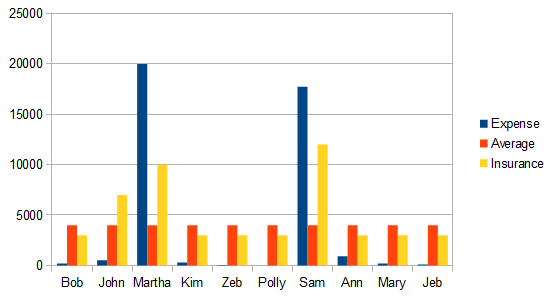
Now, say the insurance company has information about you. This could be anything, driving habits, medical, employment, credit rating, neighborhood you live in, ... The insurance company might then adjust your rates according to your predicted risk. This is good for the company, most people pay lower rates and the company will attract more of these lower risk people, but a few people pay higher rates based on risk factors. The company doesn't want to insure these people anyway and it would help the company if they went elsewhere for insurance. In the example above, the expenses and average is the same (a total expense of $40,000 for 10 people). The payment to the insurance company is the same (a total of $50,000), but there is a lower standard rate of $3,000 per person because some people pay a higher rate based on individual risks.
This is very good for the insurance company and on the surface it might seem fair to the consumers. Why should we all pay for a subset of people that choose risky lifestyles, etc. In fact it could be argued that this will actively encourage people to "clean up their act." But what if these risk factors are things people have no control over, like prior medical history or family history of a disease, etc. Also, in John's case above, he paid a higher rate but the company bet wrong; he actually had lower expenses for the period.
Now let's carry this to a ridiculous extreme to make a point. Say the insurance company had perfect predictive power; that they were able to essentially exactly predict the expense associated with each person over a long time period. What would the individuals expenses look like⸮

Above, the totals are exactly the same again, but the insurance payments are adjusted exactly according to each persons expense. Of course the company has its own internal expenses, so each person pays a bit more than their covered expense. In other words it would be better for all of these people to not have any insurance at all and just pay their own expenses. When the insurance company uses more and more information to reduce risk uncertainty, they are undermining the very reason for individuals to have insurance in the first place. There is no more shared risk and the people are just supporting a parasitic company for no benefit to themselves.
Monday, April 23, 2012
Planetary Resources
Here is an exciting news article (link).
Planetary Resources plans to send up some telescopes to look for asteroids to mine for a profit. Asteroids can contain tremendous amounts (compared to earth surface standards) of valuable rare metals. By the way, the price of platinum, gold, palladium, etc. might crash over the next few years... Just finding and reporting the contents of an asteroid, before actual mining, may make the markets realize how much is available up there. Also having common items like water (or even dirt) in space is valuable for space use because it doesn't have to be transported off the surface of a planet. Wow, V can verify that for over a decade I have suggested private companies need to start doing what the government isn't: space exploration and specifically asteroid mining. It is a positive move forward to begin building a space based economic infrastructure. I wish I could be a part of it somehow.
Planetary Resources plans to send up some telescopes to look for asteroids to mine for a profit. Asteroids can contain tremendous amounts (compared to earth surface standards) of valuable rare metals. By the way, the price of platinum, gold, palladium, etc. might crash over the next few years... Just finding and reporting the contents of an asteroid, before actual mining, may make the markets realize how much is available up there. Also having common items like water (or even dirt) in space is valuable for space use because it doesn't have to be transported off the surface of a planet. Wow, V can verify that for over a decade I have suggested private companies need to start doing what the government isn't: space exploration and specifically asteroid mining. It is a positive move forward to begin building a space based economic infrastructure. I wish I could be a part of it somehow.
Monday, March 19, 2012
Energy Production in Hawai'i
Hawai'i is in an amazing position to take advantage of renewable energy. There is great potential for wave, wind, solar, and geothermal here. Despite this, 90% of energy production comes from oil imported to Hawai'i, which makes this one of the highest rates for electricity in the nation (link and link). This is crazy. In response people have started putting up solar panels on their homes and now Hawai'i is the second in the nation, per capita, for solar power use. Companies have sprung up that will install panels on your house for free, and you pay your (lower) electric bill to them to recoup the cost. This allows homeowners to get into solar without an upfront money barrier (besides owning the home of course). However, there is an attempt here to stop solar. I heard it on the radio driving home from work and couldn't believe it. Recall that electricity is run as a monopoly that is coordinated through government regulations, and does not operate as a free capitalist market. The Hawaii Public Utilities Commission has set a limit of 15% of energy that can come from renewable sources, the rest has to come from oil! On the radio I heard that several areas are at this limit and there is effectively a moratorium on adding solar in some neighborhoods (but I have not been able to verify this last point independently). This is being fought by several solar and renewable energy organizations that are managing to get some amendments made to the ruling (link).
Tuesday, March 6, 2012
99% movement
I only recently learned more about the occupy movement and "we are the 99%" slogan. Chalk it up to being too busy working and moving a family between continents to stay on top of the news.
There is an occupy Honolulu camp in town that the police and city council have been forcing out of the park. I looked up more info about all of this.
I can certainly understand the frustration based on my own experiences. I am very pro-education, but in a strictly monetary view it does not make sense to go to grad school. Today people that begin working straight out of college make more over a lifetime than people with higher degrees. With higher degrees you go deeper into debt and spend many years making very little money. People are surprised to learn that as a postdoc (that's with a Ph.D.) at Harvard (that's Ivy League) you may make only $18,000 a year.
This is effectively less when you consider paying off college loans at the same time. And what if you have a family with dependents?
I encouraged a distant cousin of mine to go to college. Instead he went straight into his father's business after high school. He is doing much better financially than I and many people I know who went to college. This makes it hard to encourage other people to go to college.
College tuitions are unreal; it is impossible to work your way through college. (I always had a job while in college--from a janitor mopping floors to landscaping digging ditches to a security guard trying to stay awake all night--but it was never enough to pay for college.) And, your parents incomes are included in your financial calculations whether they help to pay for college or not. Also, graduate schools take advantage of students. There is the assumption you do not have dependents and the low levels of support are justified. You are required to spend thousands of dollars on things you do not need. (Example, I was forced to buy health insurance from a specific company each year in order to register for classes. I already had insurance covering me from my wife's job. Then when it came time to pay up medical bills they refused, even though it was listed as a covered expense in their handbook. So I was forced to pay for something I couldn't afford, didn't need, and gave no benefits.) And you are paid like a company town, on paper you receive money for support, but you never see all that money because it is taken right back out by the university. Also, judges have ruled that grad students are not employees and do not have the same legal protections (for example, can not organize to go on strike and refuse to teach classes).
The irony of the college situation is, we can not save for our children's college because we are paying off our own education. I opened 529 savings accounts many years ago for the kids but have only been able to put in a small amount. It is not like we are not trying to save. I also opened an IRA over a decade ago to save for retirement. I've barely been able to put in anything beyond the initial $500 to open the account. With some very lucky investments I have grown that to several thousand, but that is still nothing to retire on. (And by the way, my time spent in grad school--where I was not legally an employee, even though I worked and paid taxes--doesn't count for social security benefit calculations.)
Also, it is not like we are spending money freely. Our biggest expense after rent is health insurance (I have always made sure the kids are covered) and college loans. Then we have the utility bills, etc. We keep things turned off and try to use as little water and electricity as possible. We do cost comparisons at the grocery store and buy cheaper bulk food. I have a budget and keep track of every penny of every expense using finance software (moneydance). We would have gone under long ago if I didn't. We live cheaply. I only buy new clothes if I have to (and we get donated clothes). We have only one vehicle for a five person family. We have never owned a new car. We do not have many basic things like a microwave oven, etc. because we can get by without them. Until only recently, a little over a year ago, I never even had a cell phone (I now have a prepaid plan). My biggest indulgence in the last 10 years is my camera (my computer is a necessity for my job) and one-on-one trips with my family in 2010 (that I planned for years to do before the kids were too old). Despite all that, we are used to living from paycheck to paycheck. Usually with a gap of several days where we simply don't have any money left and are broke. Usually we keep up with rent but right now I am behind (and communicated this with our landlord so there are no surprises). Whenever we do have extra money I use it to pay off as much debt as possible. I hate to complain. I have traveled in other countries and seen what true poverty is like, but I think people in general have a mistaken idea of what my generation and people like me have to put up with financially in the US. And apparently this is more widespread than I realized.
Also, it is not like I am lazy and not working. I used to work nights, weekends, almost continuously for years in past jobs. V and I have both worked multiple jobs at times. I forced myself to stop working so much because of my health and to spend time with my family. And V and I work very hard teaching the kids to make up for a broken public education system.
I believe in paying my debts and have never planned to declare bankruptcy. However, for people in my situation this wouldn't really change anything. Educational loans are specifically exempt from bankruptcy; even if you are found bankrupt because you can't pay the loans, you still have to pay them. Why then are other people allowed to get out of car loans, house loans, and consumer debt? And companies, that should be allowed to go under if we practiced capitalism, are bailed out? (And trillions are wasted on pointless wars... )
A further difficulty is the higher your education the fewer jobs that are out there, which means you may have to move larger distances to find a job. I had to move out of the US to find a job to continue my career, which also meant I faced fines, based on past support, for leaving the US (even though it was to get a job). People in the military that move to other countries have a support structure that we can not benefit from. (As do many people that work in large companies or work for the government.) This goes all the way down to simple little things like buying a newspaper. In Germany there is a cheaper price for people in the military and then the price I had to pay. I am not trying to put down people in the military, just to point out how people can easily fall through the cracks of support structures that are assumed to be there. (We end up getting charged more to offset the lower prices of other people. And other people I talked to that had lived in Germany seemed to be unaware that I did not have the same advantages as them.) Also, my work in Germany does not count for US retirement, and my work in the US doesn't count for German retirement. So I loose out on retirement savings yet again.
Sorry about the rant. The point is, is this a system we want? Or, should we change things to encourage people to become highly educated, if they choose to do so, and be able to save for their and their children's future, which would benefit all of us in the long run?
-----
Update: Another irony is that "new" college professors do not make enough to pay off their own college loans. I know of more than one case.
Friday, January 27, 2012
NASA funding
I heard a discussion on the radio a few days ago about NASA's budget and how it would need to be trimmed and focused on fewer prioritized missions in a tough economy...
To put this into perspective, NASA receives $19 billion annually; this is less than 1% of the US budget. (link) The defense department receives $689 billion; 20% of the US budget. (link)
The international space station cost to NASA is less than $30 billion (excluding the space shuttle, $55 billion was spent on space shuttle missions to the ISS), so lets say a total of $85 billion. (link)
The second Iraq war cost at least $750 billion in direct costs to the US and may be as high a $1 trillion. (link) (Obviously this is ignoring the costs of human life, etc.)
Each state in the United States has benefited from NASA spending. In 1971 a 33% discounted rate of return was estimated for NASA investment/stimulus in the US economy. More recent reports easily show that NASA spending stimulates the economy and creates skilled jobs. (link) (This ignores the less tangible benefits arising from the US being a leader in science and technology development.)
Now is not the time to decrease funding to NASA. If anything it should be increased dramatically, and it doesn't take a lot of creativity to see where that money might come from without raising taxes. Unarguably, NASA helps the US, both in direct economic terms and in many other ways.
We, as Americans, were world leaders in space, but we have lost our vision and drive to apathy and cynicism. We build monuments on the US mall in Washington, D.C. to wars. Where are the other monuments to some of the greatest positive accomplishments the US has done, like the Apollo program and moon landing?
NASA should be doing what only governments can do. 40-50 years ago this was simply orbiting the earth, the moon landing and building a space station. Now, private companies routinely send up satellites, and are on the verge of replacing the space shuttle heavy lifting and docking with the international space station. Soon private companies, and other countries such as China, Russia and the EU will land on the moon. We need to broaden our focus and be more ambitious in our vision. NASA should be conducting manned exploration of the solar system (we need a moon base, Lagrange base, a martian space station, and a Ceres base, in that order, one of the biggest problems is radiation shielding so lets solve that problem) with more powerful non-chemical propulsion technologies, like the Orion project and VASIMR, that can accomplish manned missions to other planets in months rather than years. And we should be beginning serious unmanned exploration of interstellar space, like the Daedalus and Longshot projects, to pave the way for others to follow.
This expansion would build up a solar system wide infrastructure (and economy), so further exploration becomes easier (lower gravity wells, etc.). There are many possible benefits for earth as well. For example, we could start mining Helium-3 to solve the earth's coming energy crisis.
We can do amazing things if we just decide to do them. Let's get started!
Subscribe to:
Posts (Atom)